

Executive Summary
As artificial intelligence (AI) becomes deeply embedded in education and workplace learning ecosystems, the role of the instructional designer (ID) is undergoing a fundamental transformation. This whitepaper explores how AI is reshaping the ID profession—from automating routine tasks to enabling deeply personalized and adaptive learning—and anticipates how IDs can remain strategic architects of learning in the future.
The Evolving Landscape of Instructional Design
“Technological revolutions are not new. We as a species have shaped and been shaped by technology, from the first intentional use of stone hand axes to artificial intelligence. There has been a relentless rhythm to this progress.” – Donald Cark
Clark also says, the AI technology, especially in learning, cannot be considered in terms of “fourth industrial revolution” but rather as a “cognitive revolution.” He calls AI “a product of pure psychological endeavour.” – So, this is exactly why, we as instructional designers, must consider AI in the complete trajectory of the evolution of instructional design. Because this shift is not just technological -it is epistemological. It changes how we think about knowledge, cognition, and learning itself.
From behaviourist roots to cognitive and constructivist theories, instructional design has always been shaped by how we understand the mind. Now, with AI embodying psychological models – from pattern recognition to adaptive learning—our role expands. We are no longer just creators of learning experiences, but curators of intelligent systems that can personalize, predict, and even participate in the learning process.
This means we must ground our designs not only in pedagogy but also in an awareness of how AI mimics, augments, and sometimes redefines human learning processes. We need to ask: How does AI align with or challenge our existing design paradigms? How do we ensure ethical, inclusive, and meaningful learning in an AI-augmented environment?
Traditionally, instructional designers have focused on designing learning experiences based on structured models such as ADDIE, Bloom’s Taxonomy, and Gagne’s Nine Events of Instruction. These frameworks offer predictability, process, and pedagogical rigor. However, the rise of AI tools now challenges IDs to think beyond templates and into dynamic, data-driven, and learner-centered ecosystems.
Evolution of Instructional Design
What AI has for Instructional Design?
AI introduces:
- Automation of design and content creation (e.g., AI-generated quizzes, slide decks, voiceovers)
- Data-informed personalization based on learner behavior
- Smart analytics to measure learning outcomes and recommend improvements
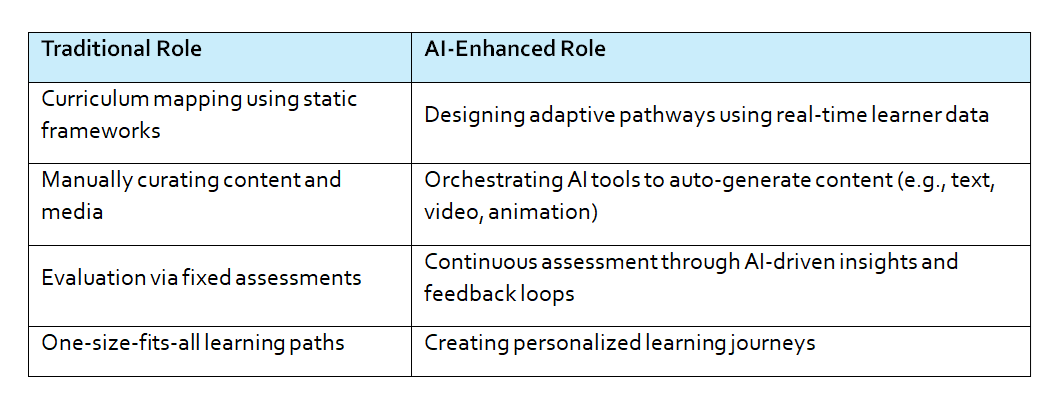
Core Responsibilities: Then vs Now
New Competencies for Instructional Designers
To stay relevant in an AI-powered landscape, instructional designers must build new skillsets:
- Prompt engineering: Crafting effective prompts for generative AI tools
- AI literacy: Understanding how algorithms make decisions and what data drives them
- Learning analytics: Interpreting dashboards and behavioral insights
- Ethical design: Addressing bias, fairness, and data privacy in AI-enhanced learning
- Human-AI collaboration: Knowing when to delegate to AI and when to intervene as a human expert
Opportunities for Redefining Value
AI frees up instructional designers from repetitive, production-heavy tasks. This opens space for more strategic and creative contributions:
- Acting as learning architects who design whole ecosystems, not just modules
- Becoming performance consultants, aligning learning to business outcomes
- Driving inclusive design with AI tools that adapt for neurodiversity and accessibility
- Leading change management as organizations adopt AI in learning
Risks and Ethical Considerations
As AI becomes more powerful, IDs must navigate new challenges:
- Loss of human touch: Over-reliance on AI may strip away empathy and nuance from learning experiences
- Bias in AI models: AI can unintentionally reinforce stereotypes or exclude minority learners
- Data privacy: IDs must understand how learner data is collected, stored, and used
- De-skilling: If IDs rely too heavily on automation, core instructional design expertise may erode
- Data Hallucinations: AI can hallucinate and provide false information. ID research and SME expertise is required
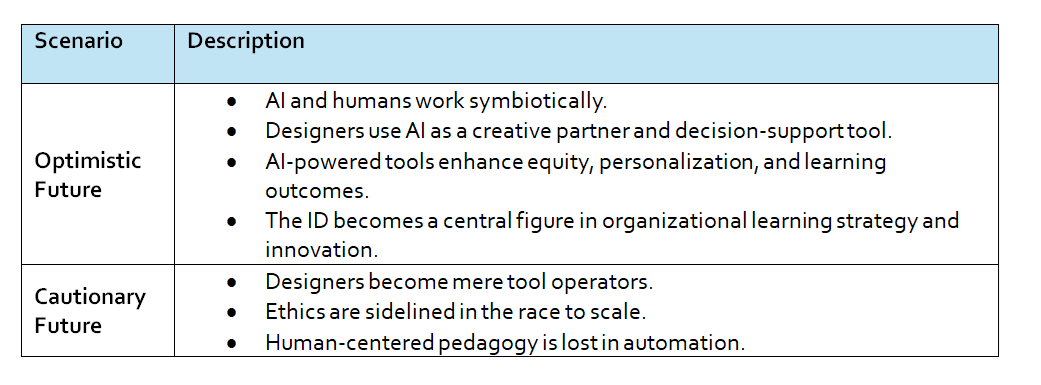
Future Scenarios: Instructional Design in The Near Future
Contributed By: Samyukhta Puligal

Tools
Type
Companies
0 responses on "The Role of Instructional Designers in the Age of AI – Part 1"