
In Part 1 of this series we looked at how the instructional design landscape has evolved over the years, till the advent of AI in current times. We also looked at how the role of the instructional designer has changed, and the new competencies that are required now to use AI effectively. In Part 2 of this series we present the AI tools that can be used by instructional designers, and the new ways of learning that have emerged as a result of AI supported with examples and use cases.
Strategic Recommendations
What is the delta for IDs and learning leaders? Here are a few:
- Upskill now: Gain working knowledge of generative AI, learning analytics, and ethical frameworks.
- Experiment: Pilot AI tools in small, controlled learning design projects.
- Stay human-centric: Use AI to enhance, not replace, empathy and pedagogical depth.
- Build communities: Join networks of future-ready instructional designers to share best practices.
Toolbox of Emerging AI Tools for Instructional Designers
Note: This keeps changing everyday.
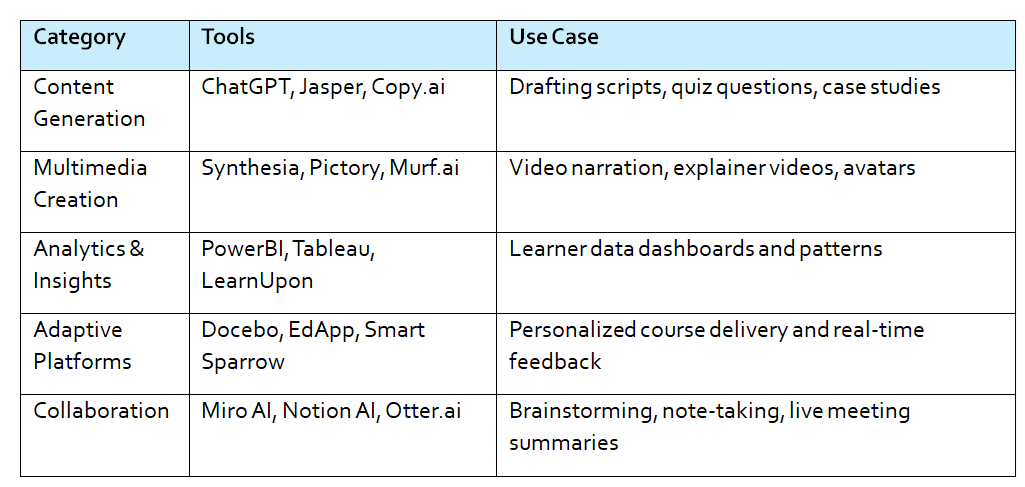
Use Cases for Collaboration Between AI And ID
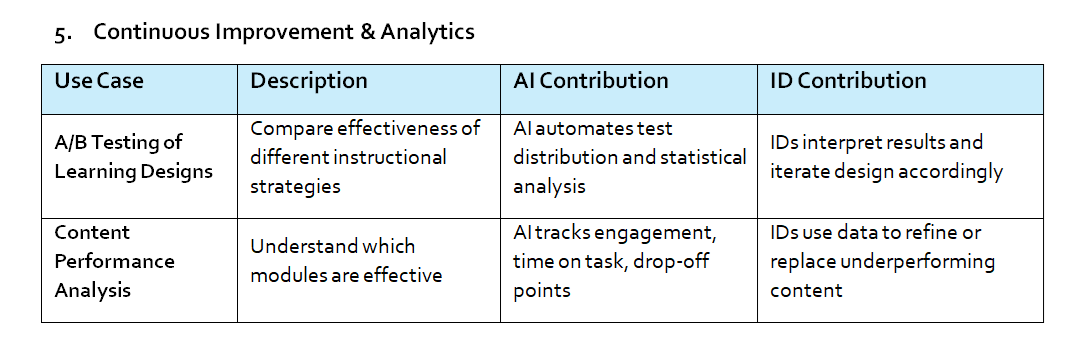
Here are use cases for collaboration between AI and ID, grouped by design stage and learning need, to understand where the constructive collaboration truly happens:

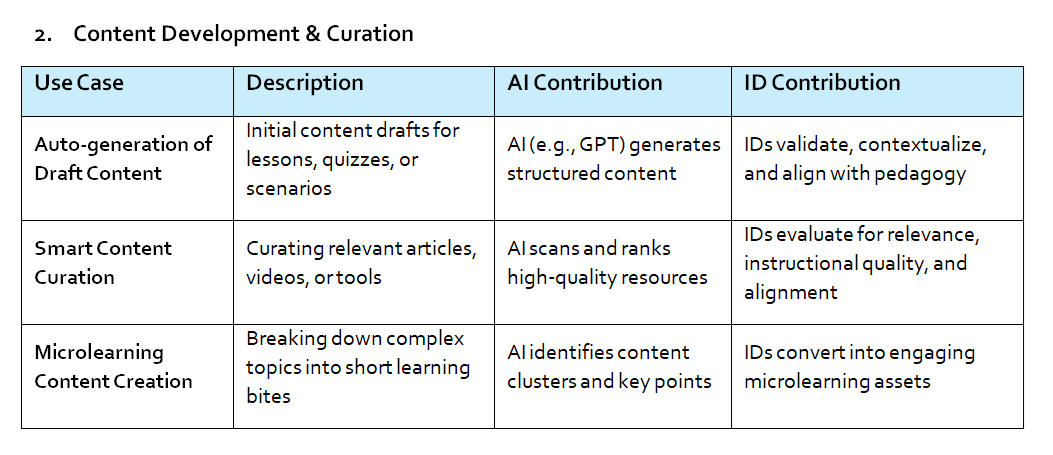
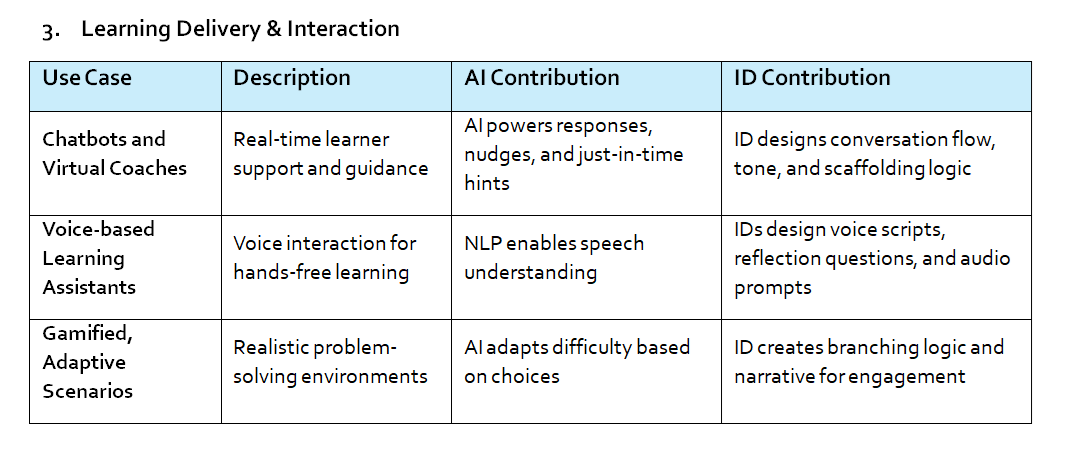
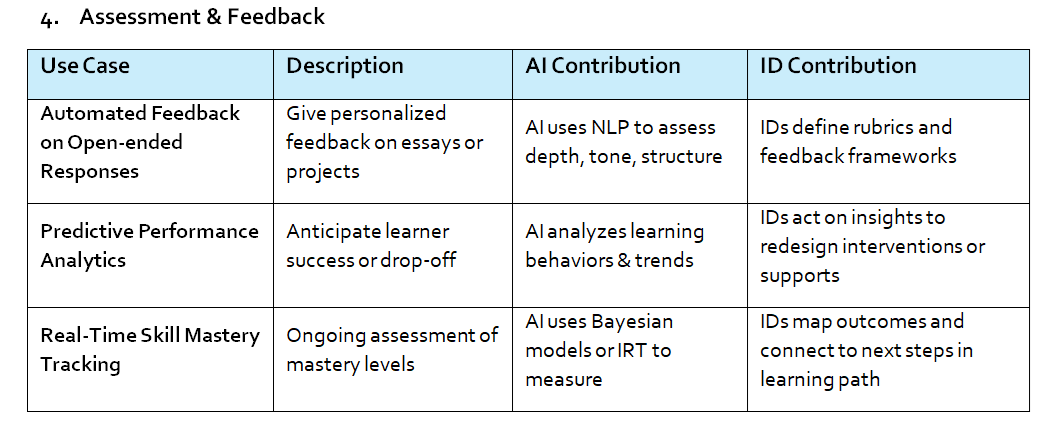
AI empowers Instructional Designers to:
- Scale personalization
- Save time on repetitive tasks
- Harness rich learner data
- Accelerate decision-making
While Instructional Designers bring:
- Pedagogical grounding
- Learner empathy
- Contextual relevance
- Ethical and inclusive design lenses
Scenario based use case examples
Scenario: A SaaS company hires 50 new software engineers across global offices. They need to be onboarded quickly on internal tools, company values, and security protocols.
Instructional Designer’s Role: Designs a blended onboarding journey with scenario-based modules, explainer videos, and compliance simulations.
AI’s Role: Tracks learners’ behavior and performance and dynamically adjusts learning paths. If someone excels in security basics, the AI skips or fast-tracks that section.
Scenario: A large retail chain wants to upskill its in-store sales team on a new product line before launch.
Instructional Designer’s Role: Designs bite-sized microlearning content delivered via a mobile app, with videos, flashcards, and short scenario quizzes.
AI’s Role: Tracks performance and recommends additional content (e.g., customer objection handling) to individuals who score low on related scenarios. AI chatbot coaches are available for real-time role-play simulations.
Scenario: A university identifies first-year students struggling with foundational math through low grades and quiz performance.
Instructional Designer’s Role: Creates a remediation module using real-world math scenarios (e.g., budgeting, cooking measurements) that encourage application.
AI’s Role: Predicts which students are at risk based on LMS interactions and sends nudges like: “Need help with percentages? Try this 3-min video.” The AI tutors provide just-in-time help via chat or voice.
Scenario: A hospital trains emergency room nurses on a new triage protocol.
Instructional Designer’s Role: Designs simulation-based scenarios with patient avatars, branching decisions, and debrief reflections.
AI’s Role: Analyzes decisions made by learners, scores based on urgency and accuracy, and adjusts the difficulty of future cases. AI also provides immediate feedback with reasoning.
Scenario: A multinational company runs a leadership program to groom mid-level managers.
Instructional Designer’s Role: Builds blended workshops with virtual coaching, case studies, and leadership reflection journals.
AI’s Role: Analyzes language used in journal entries to identify leadership strengths and gaps (e.g., lack of empathy or strategic thinking). AI chatbot simulates coaching conversations to practice soft skills.
These scenarios show how Instructional Designers provide the “learning brain” – understanding context, goals, and pedagogy, while AI serves as the “engine” scaling personalization, insights, and interactivity. Together, they enable, smarter learning, faster adaptation and stronger learner support
Conclusion
The future of instructional design lies not in competing with AI, but in collaborating with it. By integrating emerging technologies while staying grounded in the enduring principles of empathy, clarity, and equity, instructional designers can position themselves as leaders in the evolving learning landscape. To do so effectively, they must have a strong foundation in instructional design theories, frameworks, and methodologies. With this expertise, they can move beyond simply producing storyboards to delivering meaningful, strategic value in the learning experience.
Contributed By: Samyukhta Puligal

Tools
Type
Companies
0 responses on "The Role of Instructional Designers in the Age of AI – Part 2"